

AMLR is creating a growing sense of urgency across financial institutions in the EU, but many are still working out how to approach it in practice.
In conversations with customers, we’ve seen companies at all different stages of implementation.
Some have started initial assessments, while others are waiting for more clarity from the upcoming RTS (Regulatory Technical Standards).
Most are somewhere in between, aware of the impact, but still defining how to move forward in a structured way.
What makes AMLR challenging is the expectation of consistent implementation, clear governance, and the ability to explain how decisions are made across the entire AML framework.
At a recent Trapets breakfast seminar, Jonas Karlsson, Managing Director and Head of FCP at Advisense, a governance, risk and compliance powerhouse, outlined five factors that help organisations in their AMLR implementation, which we’ll highlight in this article.
What is AMLR?
The Anti-Money Laundering Regulation (AMLR) is part of the EU’s Single Rulebook, introduced to harmonise anti-money laundering and counter-terrorist financing requirements across member states.
Unlike previous directives, AMLR is directly applicable. It replaces national interpretation with a single set of rules.
It introduces:
- A unified AML framework across the EU
- Expanded customer due diligence requirements
- Stronger alignment between transaction monitoring, risk assessment, and customer profiles
- Increased transparency, including traceability of crypto transactions
- A new EU authority, AMLA, to coordinate supervision
This shift increases expectations for consistency across AML workflows. Financial institutions must be able to show how their AML framework works in practice, with clear logic and documented decisions.
5 steps to help you in your AMLR implementation
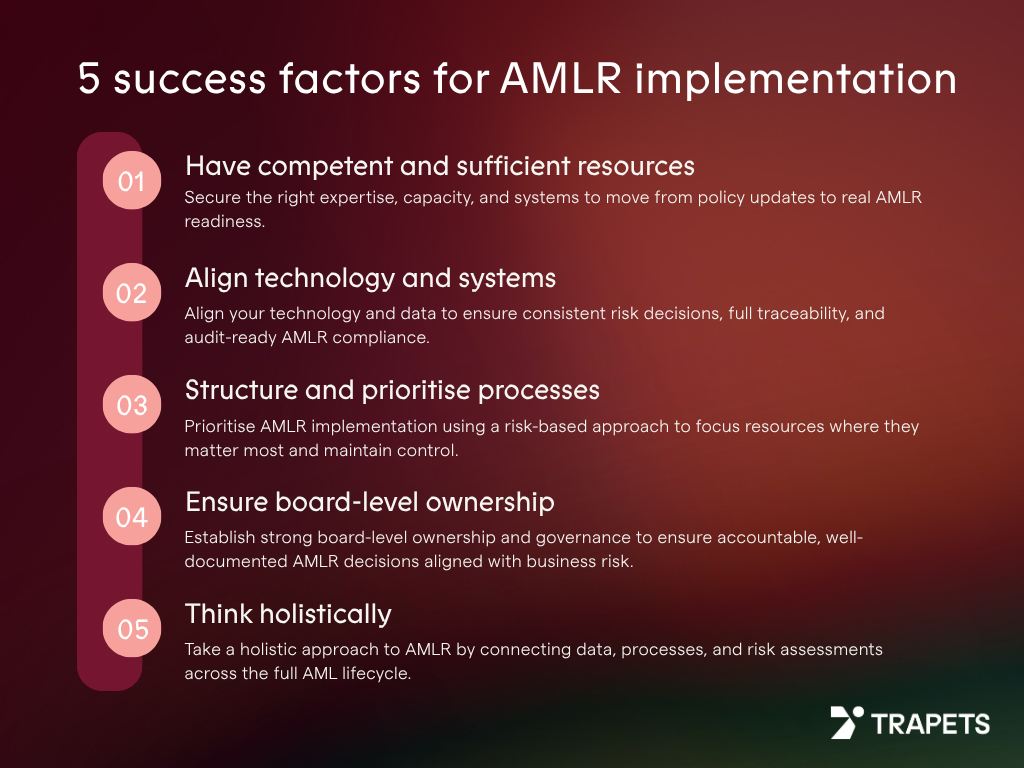
1. Have competent and sufficient resources
AMLR requires a shift in how organisations think about compliance. It's no longer enough to interpret regulations and update policies only.
As Jonas highlighted, this step represents “the shift from compliance checkbox to organisational capability”.
This shift places pressure on resources across multiple functions, such as compliance, operations, and technology.
For AML professionals, this often exposes existing gaps:
- Limited headcount and capacity across key AML functions
- Competing priorities such as DORA or MiCA
- Dependency on a few key individuals
- Limited or no budget for external support or system improvements
Without the right mix of expertise and capacity, implementation slows down, and decisions become harder to defend.
At the same time, operational teams need systems that support their daily work.
Analysts managing alerts and investigations rely on clear workflows, prioritisation, and access to consolidated data to maintain both quality and efficiency.
“Capacity planning is not the glamorous part of programme management, but it is often the difference between success and failure,” notes Jonas.
2. Align technology and systems
Technology is often where AMLR ambitions meet operational reality.
Many institutions still operate with fragmented systems across onboarding, screening, and transaction monitoring. This leads to inconsistent risk scoring, manual workarounds, and gaps in audit trails.
As Jonas puts it:
“Legacy systems are the silent killer of AMLR projects.”
For AML professionals, this creates a fundamental challenge: how to explain and defend decisions when data and logic are spread across multiple systems?
AMLR increases expectations on traceability, while supervisors will expect a clear link between risk assessments, system logic, and documented outcomes.
This requires technology that supports:
- A unified risk model across the AML lifecycle
- Consistent and structured data across processes
- Full auditability of decisions and changes
3. Structure and prioritise processes
One of the biggest risks in AMLR implementation is trying to do everything at once. Regulatory requirements are extensive, but not all carry the same urgency or risk.
“Not everything is equally urgent. Use risk to guide resource allocation.” says Jonas.
A structured approach helps organisations focus on what matters most first, whether that is risk assessment, CDD processes, or monitoring capabilities.
For AML professionals, this step is essential to maintain control over the programme. A risk-based approach ensures that implementation aligns with actual exposure, not just regulatory structure.
4. Ensure board-level ownership and governance
AMLR raises expectations on accountability at the highest level of the organisation, showing that this is not a compliance-only initiative.
“This can’t live solely in compliance; the board must own the strategic decisions,” says Jonas.
Boards and senior management must be able to demonstrate:
- Clear ownership of AML controls and risk appetite decisions
- Ongoing oversight of risk exposure
- Documented decision-making, including not only the “what”, but also the “why”, as well as how these decisions mitigate money laundering risks
For AML professionals, this changes the conversation internally. It requires translating regulatory requirements into business risk, governance structures, and reporting that resonates at the executive level.
5. Think holistically
AMLR exposes one of the most common weaknesses in AML frameworks: fragmentation.
If customer due diligence, screening, and transaction monitoring operate separately, risk assessments become inconsistent and difficult to defend.
As Jonas highlighted:
“Don’t solve articles in isolation. Map the connections across your organisation.”
For AML professionals, this is about moving towards a connected AML lifecycle where:
- Data flows across processes
- Risk assessments are consistent
- Decisions are based on a single view of the customer
How Trapets supports AMLR implementation
Trapets supports AMLR implementation by providing a unified platform where customer due diligence,screening, and transaction monitoring operate on the same data foundation and risk logic.
This helps you:
- Manage consistent risk scoring across the AML lifecycle
- Structure workflows that support efficient investigations
- Have control and full traceability of every decision
The result is greater control, stronger confidence, and an AML framework built to meet AMLR expectations and stand up to supervisory scrutiny.
Curious to learn more about how Trapets can help you in your AMLR implementation? Our experts are here to help you.